Skip to content
Pinter Computing

Knowledge Base for IT Professionals, Teachers, and Astronauts

Pinter Computing

Knowledge Base for IT Professionals, Teachers, and Astronauts

  • Home
  • Programming
  • DevOps
  • Project Management
  • Software and Hardware
  • Miscellaneous
  • Egyebek
  • About
  • Experience
  • Education
  • Contact
  • Home
  • Programming
  • DevOps
  • Project Management
  • Software and Hardware
  • Miscellaneous
  • Egyebek
  • About
  • Experience
  • Education
  • Contact
Close

Search

Home/Knowledge Base/Kubernetes Dashboard
Knowledge Base

Kubernetes Dashboard

By Laszlo Pinter
August 11, 2019 1 Min Read
0

This is the official Kubernetes dashboard, and for security reasons currently it is not recommended to use, but we can still use it in our local cluster to inspect the resources.

The latest installation information is at https://kubernetes.io/docs/tasks/access-application-cluster/web-ui-dashboard/

Launch the Kubernetes Dashboard

To launch the Kubernetes Dashboard in your cluster execute the command

kubectl apply -f https://raw.githubusercontent.com/kubernetes/dashboard/v2.0.0-beta1/aio/deploy/recommended.yaml

Create a proxy to access the cluster. The proxy will run in the background, to stop it when not needed anymore press CTRL-C.

kubectl proxy

To open the Kubernetes Dashboard web UI in a web browser navigate to http://localhost:8001/api/v1/namespaces/kubernetes-dashboard/services/https:kubernetes-dashboard:/proxy/

Start the Kubernetes Dashboard

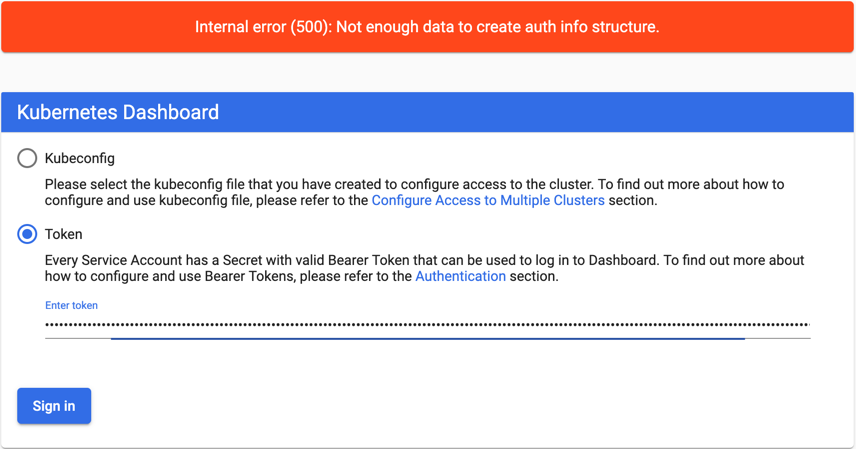
If you get the error message: Internal error (500): Not enough data to create auth info structure.

  • Execute the commands to add the token to the ~/.kube/config file
TOKEN=$(kubectl -n kube-system describe secret default| awk '$1=="token:"{print $2}')
kubectl config set-credentials kubernetes-admin --token="${TOKEN}"
  • Copy the token from the ~/.kube/config file to the login screen
Tags:

DevOpsKubernetes
Author

Laszlo Pinter

Follow Me
Other Articles
Previous

Troubleshooting Kubernetes Ingress-Nginx

Next

Learn Kubernetes part 2 – NGINX Ingress Controller

No Comment! Be the first one.

Leave a Reply Cancel reply

Your email address will not be published. Required fields are marked *

Search

Last Changes

  • Install Git on Windows October 16, 2026
  • How to create a bootable USB drive to install Windows 11 October 11, 2026
  • Nautilus U618 exercise bike magnetic brake adjustment October 11, 2026
  • Health October 11, 2026
  • Limit the battery charge level on MSI laptops October 7, 2026

Tags

.NET .NETcore 3Dprinting ASP.NET Core AutodeskInventor AWS C# Chef cloud DevOps Docker EntityFramework Git Go iOS iPad iPhone iPod Java Kubernetes Linux MacOSX MSSQL MVC MySql Node.js Packer PowerShell Python RDS RightScale Ruby security Splunk TeamCity Terraform TestKitchen Tomcat Ubuntu Vagrant VirtualBox VisualStudio Windows WordPress Xcode

Recent Comments

  • Laszlo Pinter on Turn off the built in touchpad when a mouse is attached
  • Kenneth Bush on Turn off the built in touchpad when a mouse is attached
  • Zengei László on MyHeritage családfa exportálása és küldése emailben
  • Raúl Castillo on DynDns update error
  • MICHAEL on Windows Media Player 12 cannot find the album information

–

  • Log in
  • Entries feed
  • Comments feed
  • WordPress.org
Copyright 2026 — Pinter Computing. All rights reserved.